

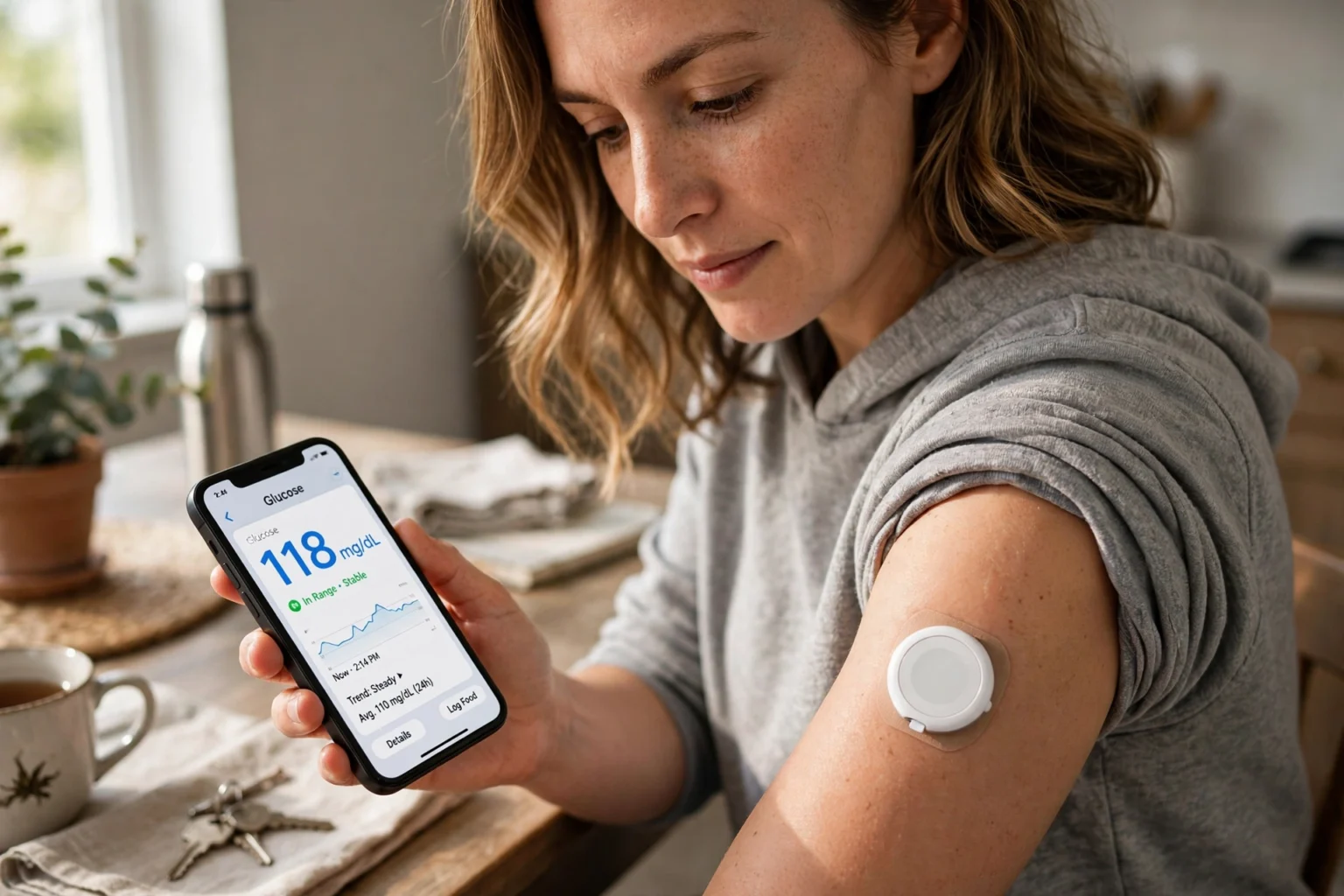

Continuous glucose monitors could help many more people with type 2 diabetes than currently use them, according to the largest clinical trial of its kind, published in the New England Journal of Medicine. The study found that adults with type 2 diabetes who do not use insulin spent approximately five more hours a day in their target blood sugar range when they used a continuous glucose monitor.
That is a striking result, because these small wearable sensors have traditionally been associated mainly with people who use insulin. For the much larger group managing type 2 diabetes with diet, exercise and oral medication, blood sugar checks have usually meant occasional finger-prick tests, which show a single moment in time rather than a pattern.
What the Trial Actually Measured
Researchers measured ‘time in range’ — the share of the day a person’s glucose stays within a healthy target band. It is increasingly seen as a more useful measure than a single average, because it captures both the highs that damage blood vessels over time and the lows that can make people feel unwell. An extra five hours a day in range is, by any standard, a large improvement.
A continuous glucose monitor is a small sensor worn on the arm or abdomen. It reads glucose levels in the fluid under the skin every few minutes and sends the results to a phone or reader. Instead of a snapshot, users see a graph: what happened after breakfast, how a walk changed the curve, and whether levels drifted up overnight.
Why Seeing the Pattern Changes Behaviour
Clinicians who work with these devices say the technology’s power is feedback. When people can see, within the hour, how a particular meal, a short walk or a poor night’s sleep affects their glucose, the advice they have heard for years becomes personal and concrete. Small experiments become possible: the same lunch with and without a walk afterwards produces visibly different curves.
Sleep is part of that picture too. As our coverage of morning light, better sleep and the body clock explained, daily rhythms influence metabolism in ways people are only beginning to track. Related reporting on why you keep waking up at 3 a.m. also shows how closely sleep, hormones and blood sugar are linked.
Who Could Benefit Most
The trial’s population matters. Participants were adults with type 2 diabetes who were not using insulin — a group that numbers in the millions worldwide and that has historically had the least access to monitoring technology. If sensors help this group keep glucose in range for substantially longer each day, the long-term effect on complications such as eye, kidney and nerve damage could be significant, although longer studies will be needed to confirm that.
There are practical questions, of course. Sensors cost money, they need replacing regularly, and not every health system reimburses them for people who do not use insulin. There is also the question of data overload: a stream of readings every few minutes helps some people and overwhelms others. Good support from diabetes teams makes a real difference in who sticks with the technology.
What Patients Should Take From the Findings
Doctors caution that a monitor is a tool, not a treatment on its own. The improvements in the trial came because people, and their clinicians, could act on the information: adjusting meals, activity and medication with evidence rather than guesswork. Anyone interested in trying a sensor should discuss it with their own care team, particularly if they take medication that can cause low blood sugar.
The New England Journal of Medicine, which published the trial, is one of the world’s most influential medical journals, and the scale of this study gives its findings weight. Guidance from organisations such as the American Diabetes Association already recognises time in range as an important goal in diabetes care.
For people living with type 2 diabetes, the message is encouraging. A technology once reserved for a minority could soon become a routine part of care, offering something finger-prick testing never could: a clear, hour-by-hour picture of what is working, and five more hours a day spent where it matters most — in range.