

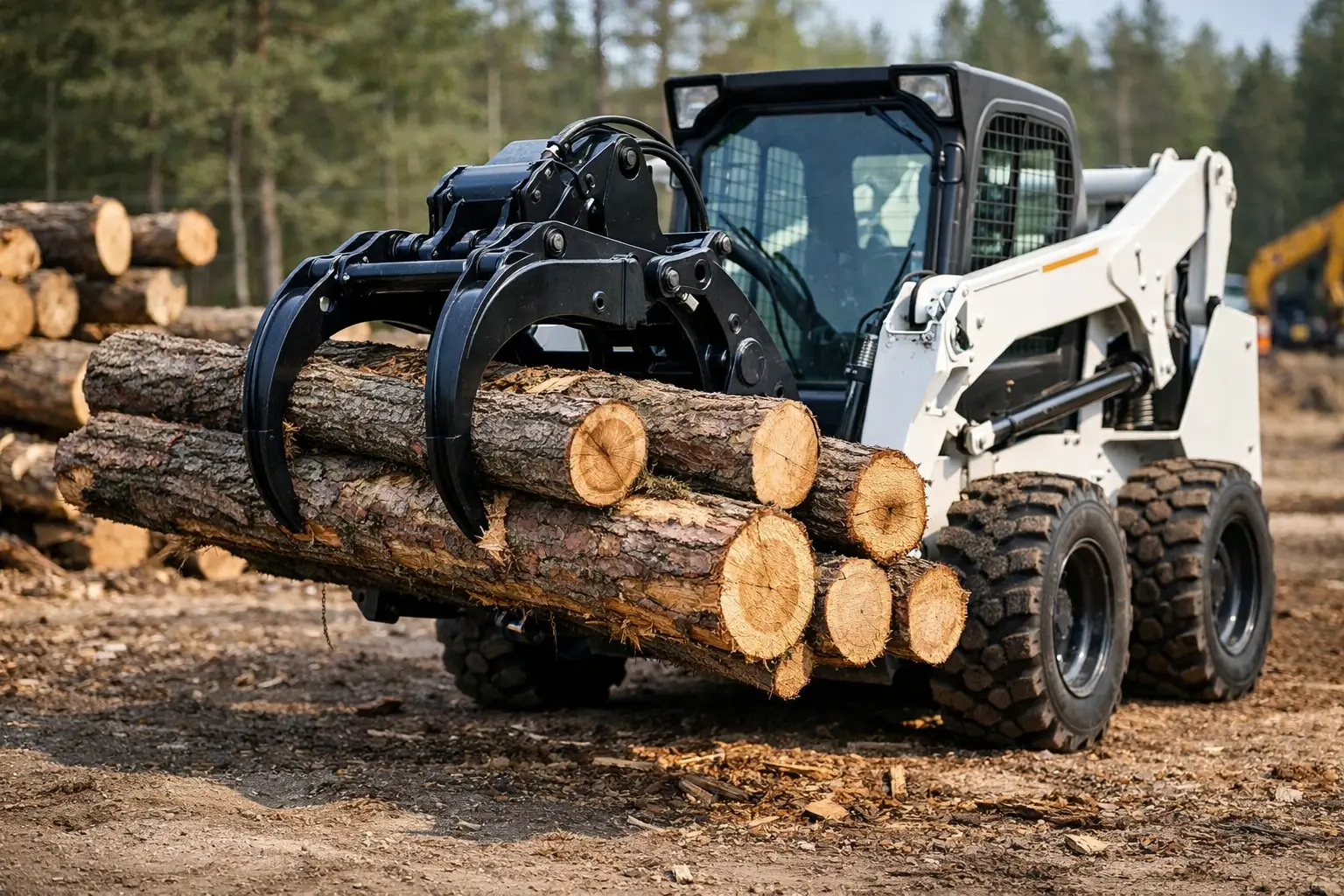

A skid steer grapple is compared on jaw opening and on closing force, and both read like capability. Neither explains why one attachment holds a log through a reversing turn and another drops it on the second lift. That behaviour comes from geometry: how many points touch the log, where they sit, and what stops it rolling out. A 760 mm log grapple attachment is a shape before it is a force.
A round log needs two points and a stop
A flat bucket edge touches a log along a single line, which is a hinge. Close a jaw onto that and the log is held between two lines, free to rotate between them the moment anything pushes on one end.
A tined skid steer grapple solves it with geometry. A curved lower tine set cradles the log at two separated points and the upper jaw provides the third, so the log sits in a triangle rather than between two edges. That arrangement resists rolling without needing much clamping force at all.
Closing force against holding force
Closing force is what the cylinders produce. Holding force is what the geometry converts that into at the contact points, and the two are not the same number. A jaw that closes at a shallow angle to the log applies most of its force along the surface rather than into it, which is why a grapple can be squeezing hard and still let a log slip. A jaw that meets the log closer to perpendicular turns the same cylinder force into grip.
Why opening width matters more than it looks
A 760 millimetre opening sets the largest log the attachment can take in one bite. It also sets the smallest, because a jaw opened wide and closed onto a thin log meets it at a poor angle and holds it badly.
The practical range is narrower than the specification suggests at both ends. Most operators find that logs between a third and three quarters of the maximum opening are the ones the attachment handles confidently, and that is worth knowing before a day of small timber.
Where the mount takes the load when a log swings
A log held at one end swings when the machine turns, and that swing arrives at the mount plate as a torsional load. The quick attach plate is strong vertically and far less so in twist.
This is the failure mode that shows up as cracked welds around the mount rather than as a bent grapple. Carrying logs short and low, with the load close to the machine, is what keeps that load manageable.
Single cylinder and twin cylinder arrangements
On a skid steer grapple, a single cylinder driving a cross shaft is simpler, cheaper and applies its force at one point on the jaw. A twin cylinder arrangement applies force at both ends of the jaw and keeps it parallel to the tines through the stroke.
The difference shows on uneven loads. Picking up two logs of different diameters twists a single cylinder jaw, where a twin arrangement closes on both. For a mixed load of firewood lengths that is the configuration that works.
What the auxiliary circuit has to do
A grapple jaw needs auxiliary flow, and it is a low volume high pressure function rather than a high flow one. Standard flow suits it, and the circuit matters more than the pump. What it needs is a circuit that holds position without the operator keeping a switch pressed. Reversing a machine while holding a toggle is two jobs at once, and on a loaded grapple it is the moment a log gets dropped.
The three parts that wear out
Three places take the load:
- Pivot pins and bushes at the jaw
- Tine tips where they contact ground
- Cylinder rods exposed when fully open
Tine tips are the one operators underestimate. Using a grapple to rake ground wears the tips at an angle, and a rounded tine cannot get under a log lying flat, which is when the attachment starts to feel useless.
Greasing is most of the maintenance
Pivot pins are in a dirty position and carry load in both directions. Grease on schedule keeps the bushes round, and a bush that has worn oval lets the jaw twist, which loads one tine instead of the set.
Cylinder rods deserve a look at the same time. A rod scored by bark and grit destroys its seal, and a leaking grapple cylinder is an attachment out of service rather than one to work around.
Tine spacing decides what falls through
The gaps between tines are what let soil, bark and short offcuts drop out while the timber stays. Close spacing holds smaller material and clogs with dirt; wide spacing self cleans and lets anything short fall through.
That is a choice rather than a quality difference. A grapple bucket with a solid floor is the other end of the same spectrum, and it holds everything including the material that should have been left behind. For firewood lengths and brush, wider tines and a lighter attachment usually move more per hour.
Reach, visibility and where the load sits
An attachment that holds a log out in front of the machine puts the load at the end of a lever. The further forward it sits, the more it reduces what the carrier can lift and the more it affects stability on a slope.
Visibility matters as much. A log held high blocks the operator view across the yard, and the usual answer is to carry low and look over rather than through. A log grab used at chest height is both more stable and easier to place.
When a bucket is the better tool
Loose material, soil and short offcuts are bucket work. A grapple handles long pieces that a bucket cannot hold, and using it for anything that pours through the tines wastes both time and the tine tips. The honest division is length. Anything that will sit across the tines suits the grapple; anything that falls between them belongs in a bucket, and most yards need both.
Reading the specification past the opening
On a skid steer grapple, jaw opening, weight and mount standard decide whether it fits the machine. Tine spacing, cylinder arrangement, whether the tips are replaceable and the required auxiliary flow describe how it performs across a season of mixed timber.
TMG Industrial builds this one at 760 millimetres for skid steer carriers. Matching the jaw opening to the timber that actually gets handled, rather than to the largest log imaginable, is what makes the attachment feel right in use.