

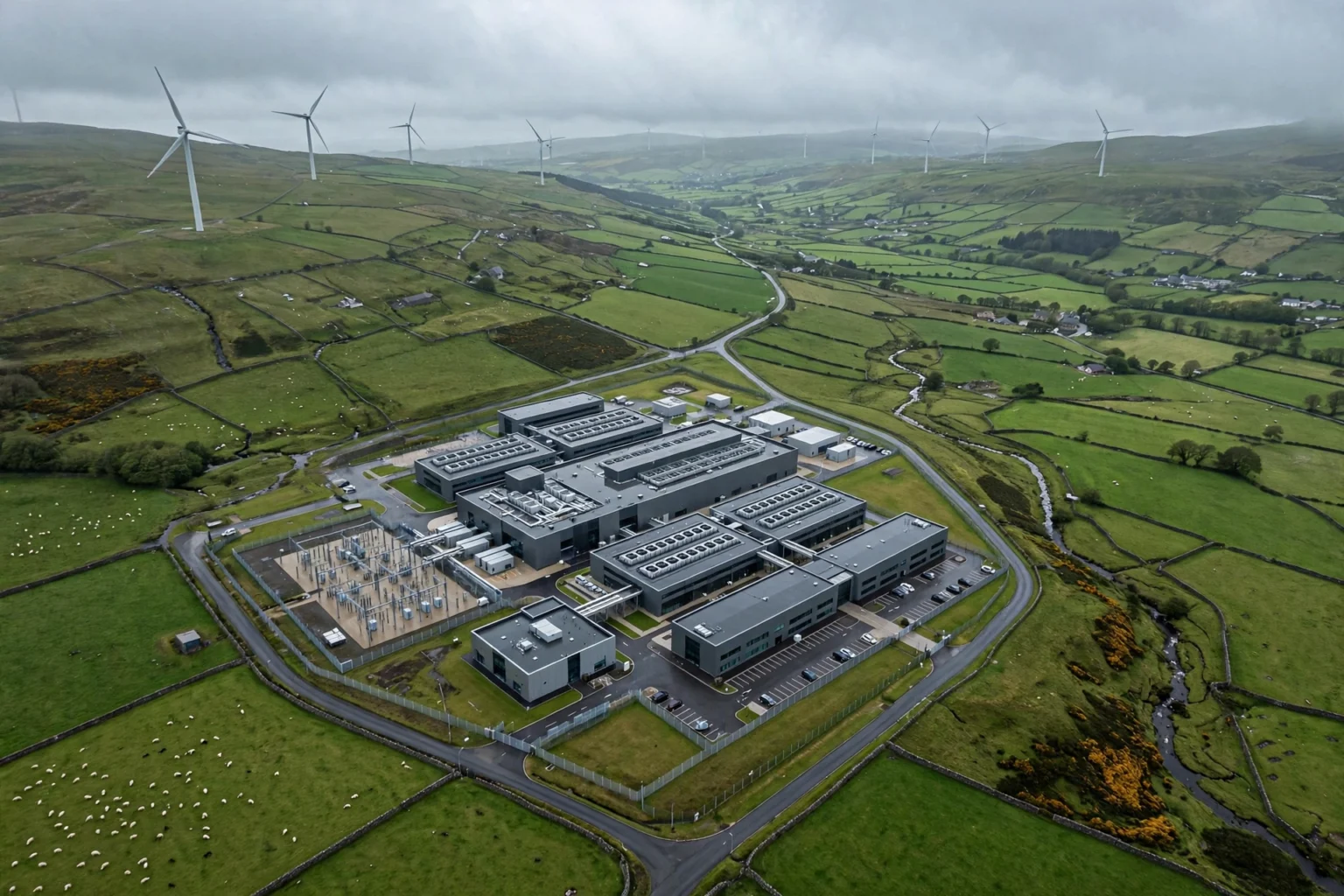

Ireland’s rise as one of Europe’s favourite homes for data centres was never an accident. English-speaking, well educated, plugged into transatlantic cables and offering a mild climate that keeps cooling costs down, the country spent two decades welcoming the server farms of the world’s biggest technology firms. But success has brought a reckoning: the buildings that power the cloud now consume roughly a fifth of all metered electricity in the state, and the national grid is straining to keep pace with artificial intelligence’s appetite for power.
How Big Is the Appetite?
Figures from the Central Statistics Office have repeatedly shown data centres’ share of Ireland’s electricity demand climbing year after year, passing the output used by all urban households combined. The growth is not slowing. Every new generation of AI models requires more computing power to train and run, and operators continue to file connection requests for facilities clustered around Dublin, where fibre routes and skilled staff are easiest to find.
The grid operator, EirGrid, has warned that demand growth of this scale is unlike anything the system was designed for. Electricity networks are built for gradual change; data centres arrive in enormous, sudden blocks, each one drawing as much power as a medium-sized town.
The Dublin Bottleneck
The pressure is most acute in the capital region. For several years, new data centre connections in the greater Dublin area have effectively been assessed case by case, with developers asked to demonstrate on-site generation, storage or flexibility before being allowed to plug in. The policy was meant to protect supply for homes and other businesses while transmission upgrades catch up.
Industry groups argue the approach risks pushing investment to competitor countries. Technology companies employ tens of thousands of people in Ireland and anchor a large share of corporation tax receipts. Their warning is blunt: servers will be built somewhere, and if Ireland cannot power them, France, Spain or the Nordics gladly will.
Renewables Are the Only Way Through
Ireland’s climate plan leans heavily on wind — onshore today, offshore tomorrow. The state aims to generate the large majority of its electricity from renewables by 2030, a target tracked by the Sustainable Energy Authority of Ireland. In theory, few countries are better placed: Atlantic winds are among the strongest and most consistent in Europe.
In practice, the build-out is slow. Offshore projects face long planning and consenting timelines, grid connections queue for years, and onshore developments regularly meet local opposition. Battery storage and interconnection with Britain and France help at the margins, but they cannot substitute for generation that has not yet been built.
What Flexibility Could Buy
One idea gaining ground is flexibility: data centres that can throttle non-urgent computing when the grid is tight, run more of their own backup generation, or even feed stored power back at peak times. Pilot arrangements already exist, and regulators increasingly expect large users to behave like partners in the system rather than passive consumers of it.
Waste heat is another frontier. A small number of facilities already pipe excess heat into district heating networks, warming homes and public buildings. Advocates say making heat reuse a condition of new connections would turn an environmental liability into a community asset.
A National Conversation, Not Just an Energy One
Strip away the engineering and Ireland’s data centre debate is really about what kind of economy the country wants. The sector brings high-value jobs, export earnings and strategic relevance. It also competes with housing, electrified transport and heat pumps for a finite supply of clean electricity during the years when that supply is still being built.
For readers following how Ireland balances growth against grid reality, our recent coverage of the wider energy transition is a useful companion — see this related report for background. The choices made in the next two or three years, on connections policy, offshore wind delivery and grid investment, will shape the sector for decades. The boom is not over; it is simply entering its hardest phase, where power — not land, not talent, not tax — is the scarce resource.