

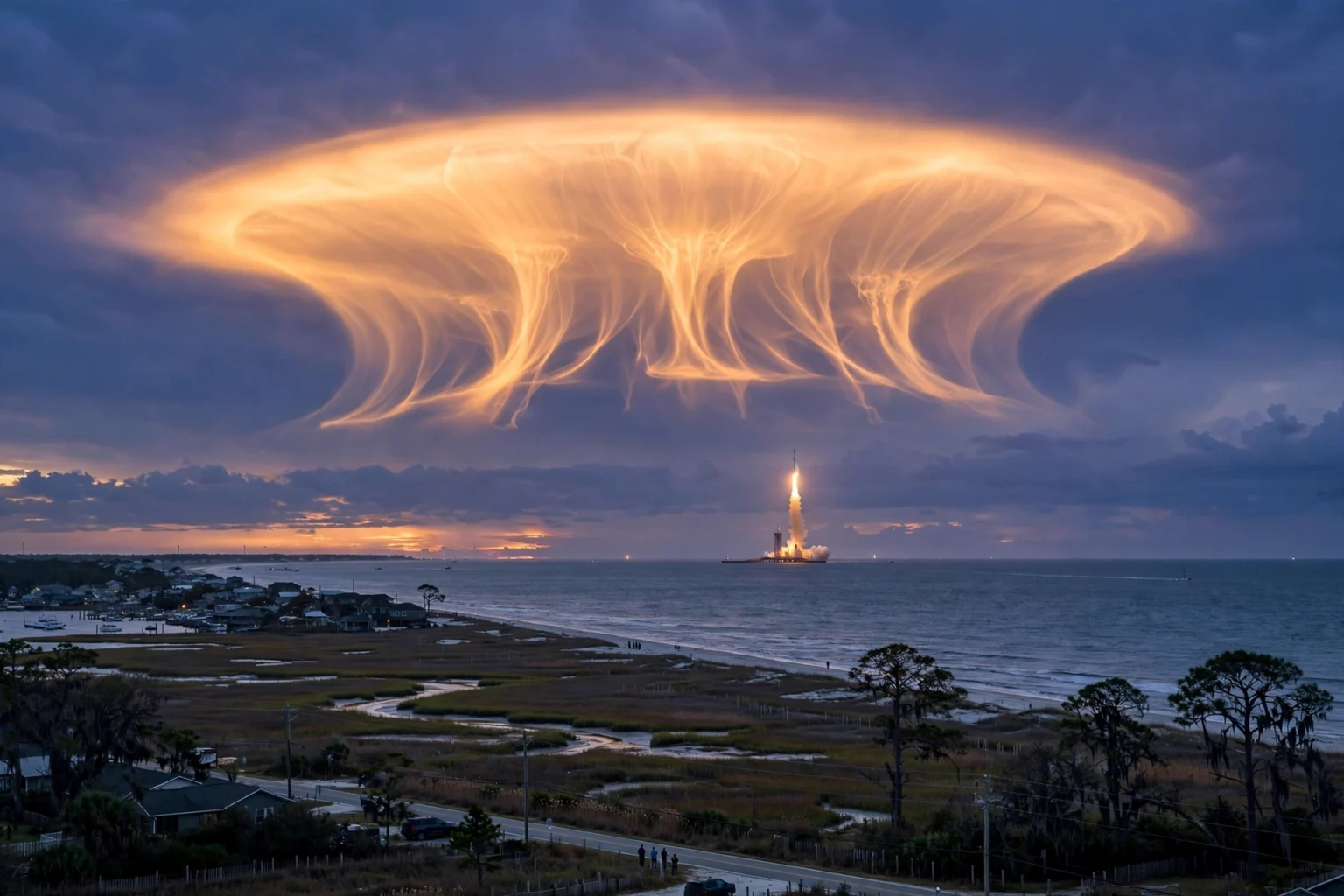

Early risers along the US east coast were treated to an extraordinary sight this week when a SpaceX rocket launch created a stunning ‘jellyfish cloud’ in the twilight sky. As the rocket climbed through the upper atmosphere in the darkness before dawn, its exhaust plume expanded and caught the light of a sun that had not yet risen for observers on the ground, producing a glowing, translucent shape with a bright head and long, trailing tendrils.
Photographs shared from coastal communities showed the luminous cloud hanging over the ocean, changing shape as high-altitude winds stretched the plume. For many people who saw it without warning, the first reaction was confusion. Within minutes, however, the explanation became clear: a scheduled launch, perfect timing and unusually clear skies had combined to create one of the most photogenic sights in modern spaceflight.
Why a Rocket Launch Creates a Jellyfish Cloud
The phenomenon, often called a space jellyfish, happens when a rocket launches shortly before sunrise or shortly after sunset. On the ground it is still dark, but at altitude the rocket and its exhaust are already in sunlight. The plume of gases expands rapidly in the thin upper atmosphere, forming a broad cloud that glows against the dark sky below it.
As the vehicle gains height, that plume spreads rather than holding the tight, smoky column seen in daytime launches. The result is a rounded, brightly lit head, followed by wispy trails that drift and curl. Observers compare it to a jellyfish, a comet and even a giant glowing tadpole, depending on the angle from which they see it.
Conditions have to align precisely. Launch too early and there is not enough sunlight at altitude to illuminate the plume. Launch too late and the sky is already bright, washing the effect out. That narrow window is why dawn and dusk launches are prized by photographers, and why this week’s display drew such a wide audience along the coast.
What Skywatchers Saw Along the Coast
Reports described a bright point of light rising, then blooming into a wide, pale cloud that seemed to hover. Some viewers watched the tendrils lengthen for several minutes as the plume dispersed, while others caught only the final, fading glow as daylight arrived. The sight was visible over a remarkably wide area because the illuminated plume sat so high above the surface.
Events like this are a reminder of how routine spaceflight has become, and how visible it now is to the public. Ireland has its own fast-growing stake in the space and technology economy, a theme explored in our recent coverage of Ireland’s data centre boom and its power grid reckoning, where the infrastructure behind the digital economy meets very physical limits.
How to See One Yourself
If you want to catch a jellyfish cloud, start with the launch schedule and look for liftoffs in the hour before sunrise or the hour after sunset, local time. Choose a viewing point with a clear, dark horizon in the direction of the launch site, and give your eyes several minutes to adjust. A phone camera on a long exposure setting can reveal colours and structure that are hard to see unaided, though the brightest displays need no equipment at all.
Weather matters as much as timing. Low cloud on the ground will hide the show entirely, while thin high cloud can soften it. Clear, calm mornings offer the best chance, and coastal locations are ideal because there is nothing between the viewer and the horizon. Our recent piece on remote work transforming Ireland’s small towns noted how many people now start their day in quiet coastal and rural places — exactly the settings where a dawn launch display is easiest to appreciate.
A Growing Spectacle of the Space Age
Launch rates have climbed sharply in recent years, driven by satellite constellations, cargo missions and crew flights. That means twilight phenomena are being seen, photographed and shared far more often than they were a decade ago. Each widely seen display also tends to prompt the same public questions: what was it, was it planned, and when will it happen again?
Reporting by The Guardian documented this week’s sighting and the reaction from skywatchers along the coast. Space agencies and launch providers such as SpaceX publish upcoming missions in advance, so the next opportunity is rarely far away.
For now, this week’s jellyfish cloud stands as one of those rare moments when advanced technology produces something purely beautiful, visible free of charge to anyone who happened to look up at the right minute. If you missed it, set an early alarm for the next dawn launch window. The space age, it turns out, puts on its best shows before breakfast.