

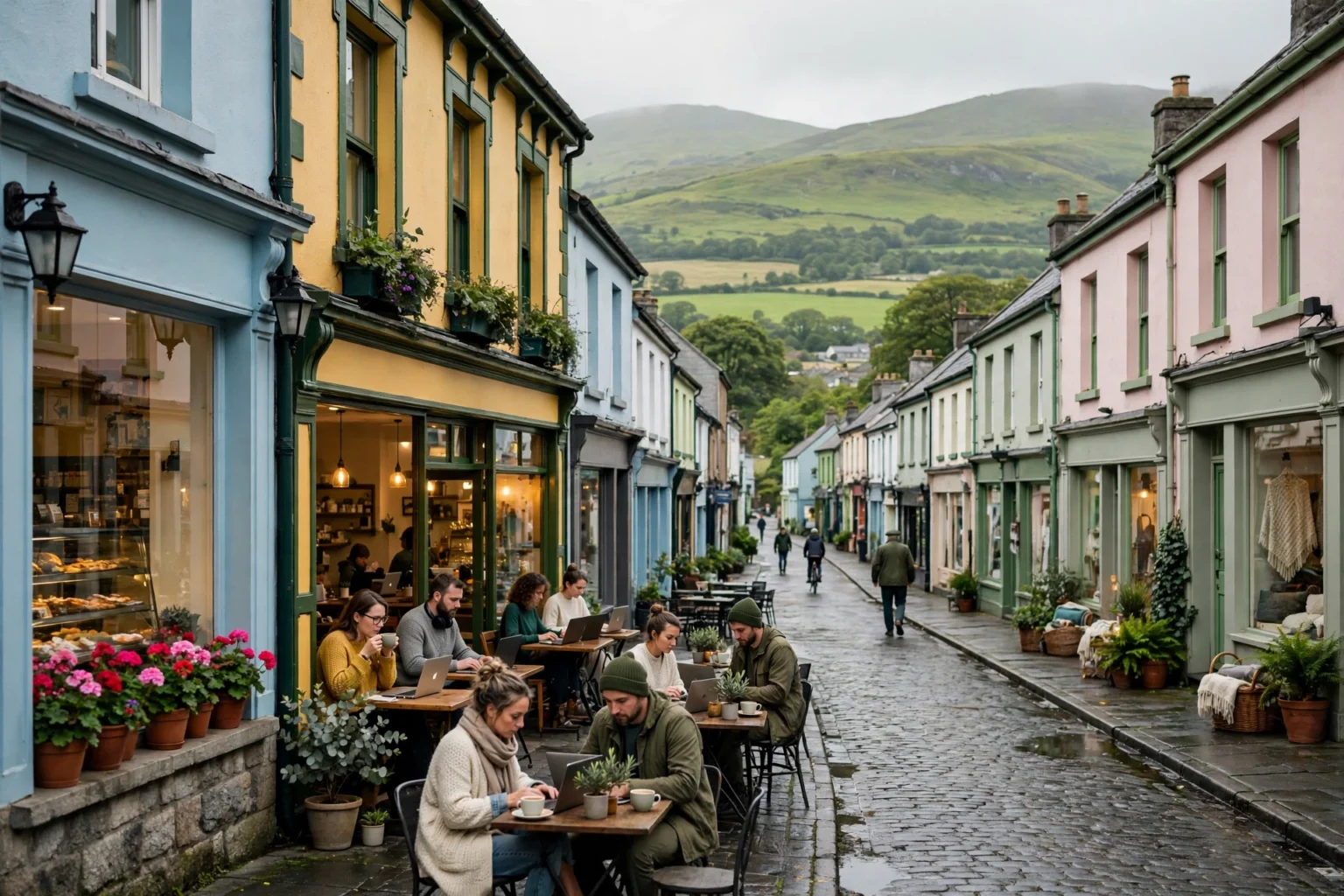

Five years ago, the story of Ireland’s small towns was one of slow decline: young people leaving, shops closing, main streets hollowing out. In 2026, a different story is being written — and it is being typed from kitchen tables and converted spare rooms across the country. Remote work has become the biggest rural development force in a generation.
Figures from the Central Statistics Office show sustained growth in people working mainly from home outside the big cities. Town councils that once chased factories now compete for remote workers: co-working hubs in old bank buildings, fibre broadband rollouts and relocation grants.
New life on old streets
The changes are visible. Cafes that survived on weekend trade now serve laptop crowds on Tuesdays. Young families who could never afford Dublin are buying in towns their grandparents left, enrolling children in local schools and joining GAA clubs. Estate agents in several counties report that a good broadband connection now sells a house as surely as a good roof.
It is the kind of shift we track across our news coverage: not a government programme with a launch date, but thousands of individual decisions adding up to a demographic reversal.
The frictions are real
Success brings its own problems. Rents in attractive towns have climbed sharply, squeezing locals who never left. Broadband remains patchy in exactly the scenic areas remote workers love most, and a single bad connection can end a job interview — or a job. National reporting, including coverage on RTÉ News, has highlighted the infrastructure race towns are now running.
There is also a social adjustment. Newcomers bring energy and spending, but communities are negotiating how to integrate people whose economic lives happen elsewhere — in companies in Dublin, London or New York.
A generational bet
Whether the transformation lasts depends on the next few years: on fibre reaching the last townlands, on housing supply catching up, and on employers keeping hybrid promises. If it holds, Ireland may have stumbled into the thing rural policy chased for fifty years.
What the successful towns are doing
Towns gaining the most from the shift share a few habits. They treat their co-working hub as civic infrastructure, like a library — a place where newcomers meet locals and where a returning emigrant can land softly. They market honestly: not as cheap imitations of the city, but as places with strong schools, short commutes to a desk and space to breathe. And they push hard on the unglamorous essentials — water, roads, childcare places — that decide whether a family stays for a school term or for good.
Local businesses are adapting too. Tradespeople report waiting lists as renovated cottages multiply; cafes extend hours; evening economies that died with the last recession are flickering back. Perhaps most tellingly, some towns that spent decades losing their under-30s now count them as the fastest-growing age group.
Reasons for caution
Remote work’s geography is not settled. A change in one large employer’s policy can ripple through a town’s rentals in a quarter, and hybrid patterns still favour homes within reach of a city. Housing supply remains the binding constraint: if towns cannot build sensibly and quickly, the boom curdles into a bidding war that prices out the very families it attracted.
Still, few here would trade the current problem for the old one. A town arguing about broadband speeds, school places and planning applications is a town with a future to argue about. After decades of managing decline, that is a welcome change.
Community groups have become the boom’s glue, running welcome evenings, sports clubs and volunteer networks that fold newcomers into town life quickly. Long-time residents say the real test is the second winter — but so far, most who came for the laptop lifestyle are staying for the life itself, and putting down roots that look built to last.
For now, the laptops are open, the cafes are full, and Ireland’s small towns — as we report daily on The Irish Mirror — are busier than they have been in decades.